BLOGGER TEMPLATES AND TWITTER BACKGROUNDS »

Goin' Down Music Video

You'll Love Me When I'm Famous Album

You'll Love Me When I'm Famous Album

The Dropouts Website Link

Thursday, 22 September 2011

Album Cover Analysis

From looking at a range of albums from different genres, I've been able to distinguish the key features that make up the album's composition. These generally include:

  1. Artist Name
  2. Album Title
  3. Image of artist
  4. Track List
  5. Record Label Logo
  6. Bar Code
There are different ways of categorising album covers, but often this is most easily done through the genre. Mainstream pop albums tend to feature a CU of the lead singer, whilst alternative bands lean towards using original artwork. The colour scheme is also often a key signifier, as the brighter the colours, the more attractive it is to a younger audience. Dark, gloomy images lend themselves to an older audience, that are perhaps more serious about their taste in music. However, in recent years it has been harder to identify the type of music through the album artwork, as it is currently in vogue to create something this is highly striking and original, regardless of the style and tone of the music.

For debut artists, albums usually have an image of the singer or band on the front cover, so that they become quickly recognisable to a new audience. There is a reoccuring theme of creating a very strong brand image on the debut album, for example there will be a striking font and very distinctive styling on the artist.

Music Influences

Our class held a group discussion concerning how we have been influenced to like or buy music in the past and in the present. Some very interesting points kept on being raised that seemed to apply to the entire group, so I've collected a summary of the most important notes.

As a child, musical influuence often came from:

  1. Older Siblings
  2. Parents
  3. Friends
  4. Songs taught in school
  5. Songs from popular culture, such as children's and reality talent shows.
From this, it can be seen that children tend to follow trends dictated by popular culture. Music is initially a way to fit in rather than stand out, so they tend to conform to mainstream conventions.

Beyond childhood, music tastes appear to broaden. This usually happens as people start searching for an individual style and personality. In the past, people have cornered themselves into a specific genre, but now that we have become an 'ipod generation', tastes in music are widening, instead of falling into a niche area.

Music influences beyond childhood:
Friends
  1. Youtube Searches
  2. Other internet promotions
  3. Songs from tv and film soundtracks
  4. Radio

Tuesday, 13 September 2011

Hype Williams

Hype Williams is one of the world's most popular music video directors. His first video was made in 1991, and he has consistently made videos for top artists up to the present day.

The genres that he typically works with are rap and Hip-Hop, and he frequently collaborates with Kanye West, Mary J. Blige, and LL Cool J. His videos are known for distinctive colour schemes and exotic mise-en-scene. His earlier works make use of fish-eye cameras, but more recently his videos have featured shots in regular widescreen ratio, while a second shot is split and placed in the upper and lower bars.

Will Smith - Gettin' Jiggy Wit It - 1997

This is a prime example of use fish-eye camera, which Williams used almost without fail until about 1995, where the trend came to an end. This video has high contrast between blue, white and black, and uses several inventive set-ups, such as an Egyptian theme and a dance sequence by the statue of liberty.


Jay-Z - Big Pimpin' ft. UGK - 2000


Big Pimpin' is a classic example of a rap/hip-hop video. It includes a vast array of stereotypical rap cliches, like a boat, a beach, hundreds of scantily clad women, money and alcohol running free, large party scenes and high angles. This is one of the first uses of the widescreen camera, which Williams now frequently uses, perhaps most noticeably in LL Cool J's 'Control Myself', in which the top and bottom space show a different scene.


Kanye West - Diamonds from Sierra Leone - 2005


Shot in both the Czech Republic and Sierra Leone, this video is an example of Williams movement towards broadening the locations of his videos - he would later go on to film 'Stronger' by Kanye West in Japan. The video is shot entirely in black and white, and if it weren't for West's perfomance sequences, could be presented as a short film. This idea of the 'short film as music video' was further explored in 'Blame it' by T-Pain, which had opening credits, citing Williams and several celebrity guest stars. By the mid noughties Williams had begun to stray away from traditional  rap videos, and began to explore more serious topics, such as the blood diamond industry in this video.


Coldplay - Viva La Vida - 2009
This shows Williams departure from rap or hip-hop videos, and into alternative rock. Here, he has experimented with texture,  to coincide with the album artwork for Viva La Vida or Death and All His Friends. This is a performance piece, so there are lots of shots of the vocalist and instruments, unlike in previous videos. The orange colour scheme which gives the impression of a classical painting indicates another change for Williams as he expands his music video genres.

Friday, 9 September 2011

Music and Me

Girls Don't Like Boys - Good Charlotte


 I chose this soing to reflect my time at primary school because it was one of the first songs I liked outside of the pop genre. My class was over two thirds male, it was probably because of this that I became gradually more tomboyish. For a long time, I only knew the song through everybody singing it, so when I first heard it wperfomed by Good Charlotte I remember being really excited that it was even better than I initially thought. I was also slighly judgmental of people who liked listening to harder, 'angry' rock music, so it was also a lesson to me that other genres can be just as good. My music taste has been incredibly wide ever since.

Childhood Song Shortlist 
Reach - S Club 7
Thunderbirds are  Go - Busted
Joseph's Coat of Many Colours - Joseph and the Amazing Multicoloured Dreamcoat


Spiralling - Keane


This is the song I've chosen to reflect my early teenage years. Though I didn't realise at the time, I was quite an emo child, although I was very subtle about it, which explains why the most emo my music got was Keane songs. I remeber listening to the lyrics one day and realising that they almost fully matched my life and the way I felt about things, and being happy that I'd finally found a song that 'got' me. Although it isn't really an accurate representation of me anymore, I still love the song, and use it as a running track.

Early Teenage Years Shortlist
Unwritten - Natasha Bedingfield
Overprotected - Britney Spears
Angels - Robbie Williams


Hey Soul Sister - Glee Cast


I chose this clip because it features a song I love, on a show I love, sung by some unknown actor called Darren Criss. I like it because it's arguably one of the Glee covers that manages to outdo the original, and the performance is so happy and enthusiatic that you can't help feeling like that too.

Current Songs Playlist
Teenage Dream - Katy Perry
Love Like Woe - The Ready Set
Heart Skips a Beat - Olly Murs

Monday, 18 July 2011

Prelim Evaluation

The completed task


Our group chose to base the edit on the original cut, but didn't choose to exactly match the Five video.

Evaluation of the task 


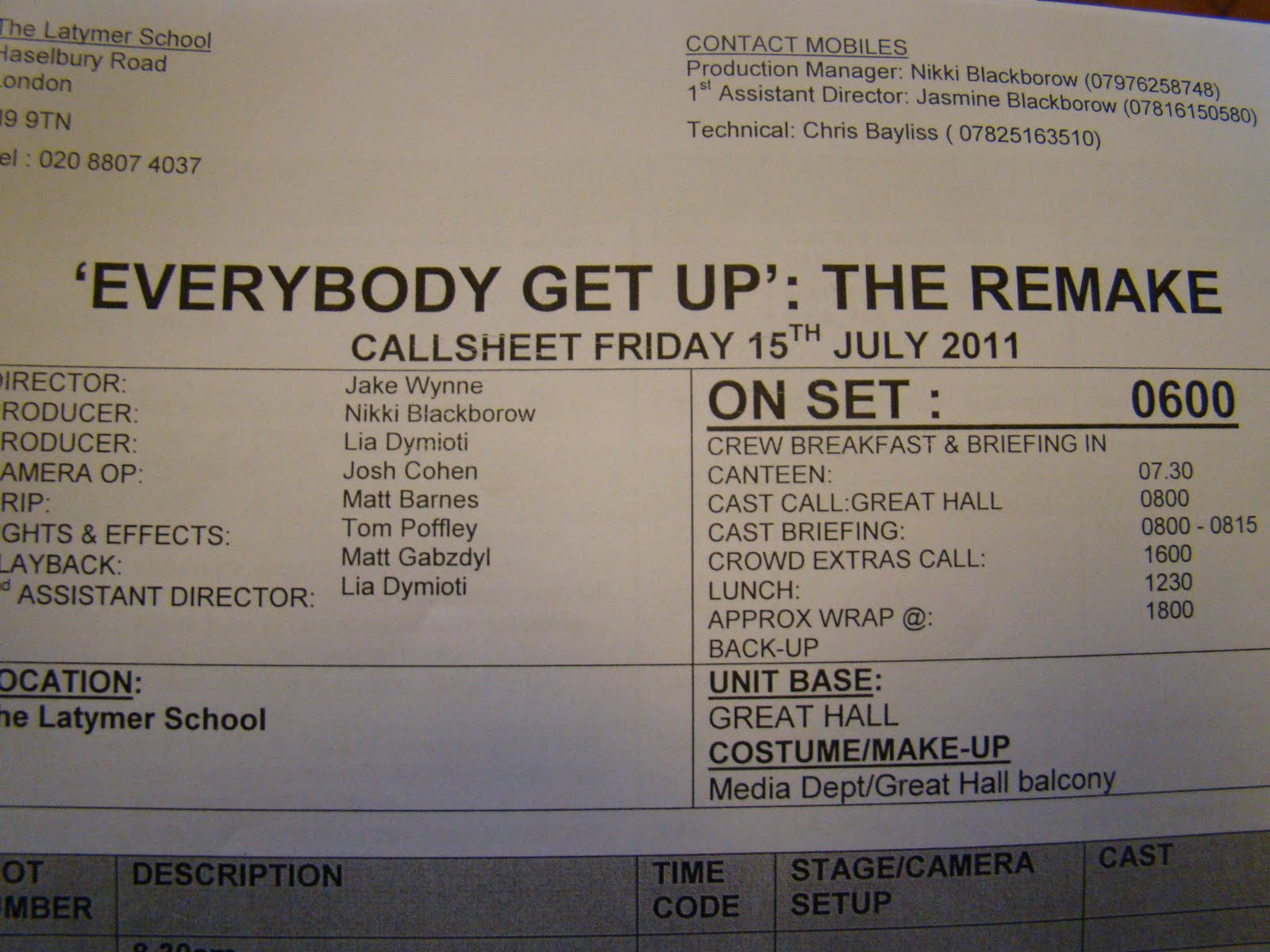
The Call Sheet
Filming behind-the-scenes footage

1. Did you enjoy the workshop day? What were your best bits and why?

I really enjoyed the workshop, and found it really interesting. My favourite parts of the day were when the entire class had to freestyle dance, as it meant that everybody got to be involved. The atmosphere throughout the whole day was really positive, probably due to the fact that it's very difficult to be miserable whilst doing 90's dance moves. It was also really good to be able to watch shots through the monitor, as we'd never been able to see the full effect of the higher quality cameras before.


Using the crash mat


Background dancing shots

Filming the performance

2. What did you learn from participating in the workshop?


Off-duty extras watch the footage

I leant that it's really important to keep up a good atmosphere throughout the shoot, as by the end everyone will be really tired. I also noticed that often it takes longer to direct the technical side of things than the actors or dancers, so we will have to take that into consideration during our own projects. In addition to this, I also realised the next day that it would help to properly warm up and down after the day, as everyone's arms were really aching!

3. Are you pleased with the footage and your edit? Is it how you expected it to look?

I am really pleased with the footage, although when we arrived in the edit suite we realised that a couple of shots were missing, or looked rather different to the originals. For this reason, our edit is based on the original cut but not identical, as we felt it would be a waste to not use other good shots.


4. How do you think your workshop experiences will impact on your approach to next term's music video coursework?

I think that the main thing is to have everything meticulously planned before the shoot, so that the actors don't get bored and distracted whilst we set up the equipment for each new shot. With any physical sequences, we should make sure that everyone on set has enough food and drink to keep going, as it's vital to have everyone on screen looking enthusiastic. Also, it took us maybe hundreds of plays of 'Everybody Get Up' before we became comfortable with the raps, so it would possibly be easier to use a slightly slower song that can be picked up easier. This would also make the edit slightly easier.

Wednesday, 6 July 2011

Five Re-Edit

A recent task we were set was to re-edit part of the original music video for 'Everybody Get Up'. To do this, we were given all the different shots in a jumbled up order, and had to cut them apart and make them fit once more with the music.


This extract took us around 30 minutes, which highlighted how complex the editing really is. For example, some of the shots are much less than a second long, meaning that we needed to do some very fine editing. What we realised in this task was that many of the shots were from the same takes, albeit presented in a spread out manner. As far as we could distinguish, there were at least 8 different camera set ups, presumably with more that ended up on the cutting room floor.

Overall, this exercise helped us understand how complex creating a music video really is, especially if there is quick editing involved. We are all looking forward to beginning the production stages next week.

Monday, 4 July 2011

Practice Lipsync- Everybody Get Up


This is our practice lip-sync to Everybody Get Up, in preparation for our day long shoot next Friday. Although this was was only a rough shoot and edit, it was invaluable in helping us to recognise the main issues we'll have to face for the actual production. For example, anyone with a verse will need to be well-rehearsed with the lyrics, and we all need to remember to perform, especially when we're not singing. As the track is a couple of minutes long, repeating shots quickly eats into your time and it's probably better to practice beforehand.

CASTING

I'd like to play the 'Red Top Girl' - as pictured below.

Photobucket

Although most of the chorus members have similar roles, I'll give out my reasons for playing this role below.

  • I can easily find a red top and dark trackies.
  • Red Top girl does a fair amount of dancing, and I used to take dance classes. This should hopefully mean that I don't look too ridiculous in the shots.
  • She also gets to stand on a table at one point, and I've never had badly hurt myself. This can only be a good sign, as this clearly makes me a safer bet when considering health and safety!
  • However, I'm happy enough to play any role, as long as I get to take part in the video!